 NationRepair
How to Choose the Right Power Bank
The portable charger market is enormous and confusing. Power banks range from pocket-sized 5,000 mAh units to briefcase-sized 50,000 mAh behemoths, with wattage ratings from 5W to 240W, multiple port types, and fast-charging technologies from different manufacturers. Most people buy the wrong one — either too small and constantly running out, or too large and too heavy to carry. This guide gives you a clear, practical framework for choosing the right power bank for your specific devices and usage patterns, so you get exactly what you need without wasting money.
The Key Specifications Explained
Capacity (mAh)
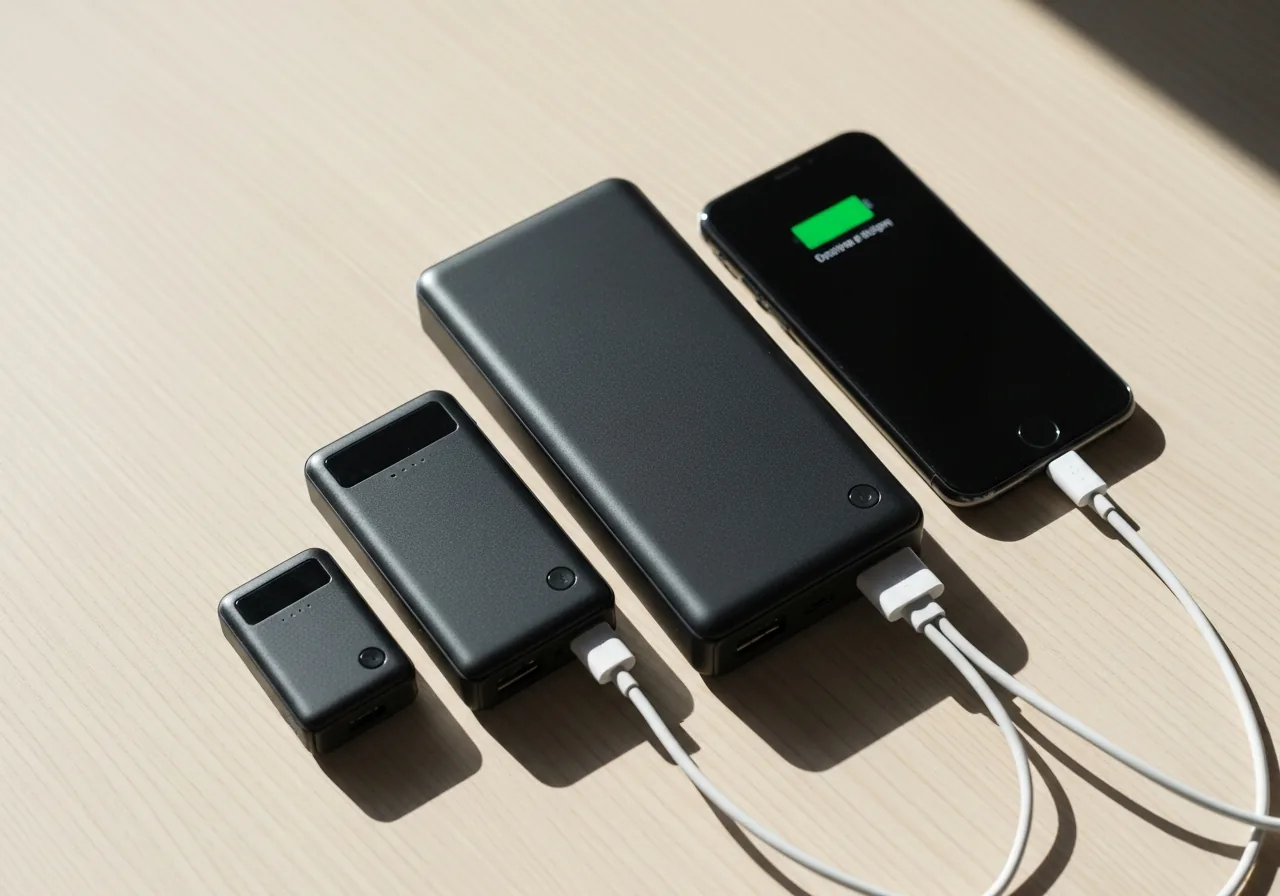
Milliamp-hours (mAh) is the total energy stored in the power bank. Higher = more charges. A rough rule: divide the power bank's mAh by your device's battery mAh to get approximate charges. Note that real-world efficiency is typically 70–85% of rated capacity due to conversion losses — a 10,000 mAh power bank delivers about 7,000–8,500 mAh of actual charge to your device. Common device battery sizes for reference: iPhone 15 ≈ 3,877 mAh, Samsung Galaxy S24 ≈ 4,000 mAh, iPad Air ≈ 7,606 mAh, MacBook Air M3 ≈ 52,600 mWh (not directly comparable).
Wattage (W)
Wattage determines how fast the power bank can charge your device. This is just as important as capacity. A 20,000 mAh power bank limited to 5W output will take 15+ hours to charge a phone — far slower than a wall charger. Look at both the input wattage (how fast the power bank itself charges) and the output wattage (how fast it charges your devices). For smartphones, 18–30W output is ideal. For laptops, you need at minimum 45W and ideally 65–100W.
Ports
USB-A outputs are universal for older cables and accessories. USB-C ports are essential for modern devices and enable Power Delivery (PD) fast charging. A power bank with at least one USB-C port and one USB-A port covers virtually all use cases. For laptop charging, look for a USB-C port explicitly rated at 65W or higher with PD 3.0 support.
Choosing by Use Case
For smartphone-only use (commuting, day trips)
A 10,000 mAh power bank at 18–20W output is the sweet spot. It fits in a jacket pocket, provides 2–2.5 full charges for most smartphones, and recharges itself in 2–3 hours. Best options at this category: Anker PowerCore 10000 PD, Belkin BPB011, or Baseus Magnetic Wireless Power Bank (if MagSafe compatibility is important).
For multiple devices or tablet charging
Move up to 20,000 mAh. These charge two phones simultaneously (usually 18W per port) or provide a meaningful top-up to a large tablet. The trade-off is weight — most 20,000 mAh units weigh 380–500g. Consider whether that weight is worth it for your use pattern. Anker PowerCore 20100, Zendure SuperTank Pro.
For laptop charging
You need a power bank rated at 65W+ USB-C PD output and at least 20,000 mAh (ideally 25,000–30,000 mAh for a reasonable number of laptop top-ups). Confirm that the power bank supports USB Power Delivery 3.0 — not all "USB-C" power banks support laptop-level wattage. Top choices: Anker 737 Power Bank (140W, 24,000 mAh), Zendure SuperTank (100W, 27,000 mAh), Baseus Blade (65W, 20,000 mAh — very slim). Note: 100W+ power banks may be subject to airline restrictions on carry-on luggage; check your airline's policy.
For camping or emergency preparedness
40,000–50,000 mAh solar-charging power banks. These are large and heavy but provide multiple days of smartphone charging. The solar panels on most of these models are supplementary (they add 3–10W of slow trickle charge) rather than primary — don't rely on solar alone to charge these from empty. Jackery Explorer series and BioLite's larger power banks are respected in this category.
Features Worth Paying For
- Pass-through charging: Allows you to simultaneously charge the power bank and the connected device. Useful for overnight charging setups.
- USB-C bidirectional port: A USB-C port that serves as both input (charging the power bank) and output (charging your devices) — reduces the cable clutter of separate input and output ports.
- Display showing remaining capacity: A percentage or LED indicator that shows how much charge remains is far more useful than the 4-dot LED bar systems on cheap power banks.
- Low-current mode: Some power banks automatically shut off when a device stops drawing significant current (like when a phone finishes charging). This is a problem for accessories like earbuds cases (which draw tiny amounts). A "low-current mode" keeps the output alive for these devices.
- GaN (Gallium Nitride) circuitry: GaN power banks are smaller and run cooler than traditional silicon designs at equivalent wattage. For high-wattage (65W+) power banks, GaN construction makes a meaningful size and weight difference.
Features Not Worth the Premium
- Built-in cables: Convenient but the cables degrade faster than the power bank itself, and replacing them when they fail requires returning the whole unit.
- Wireless charging surfaces: Wireless charging from a power bank is very inefficient — you lose 30–40% of capacity to heat in the induction process vs. wired charging's 15–20% loss. Only useful for MagSafe (iPhone 12+) where the alignment is precise enough to reduce this loss somewhat.
- Excessively large capacities (50,000+ mAh) for daily commute use: These are too heavy and bulky for daily pocket carry and may violate airline regulations. Unless you genuinely need multi-day off-grid power, 20,000 mAh is the practical ceiling for daily-use power banks.

Aviation Rules for Power Banks
Airlines restrict power banks in checked luggage — they must always go in carry-on. Capacity limits also apply: most airlines allow up to 100 Wh (approximately 27,000 mAh at 3.7V) without pre-approval, and up to 160 Wh (approximately 43,000 mAh) with airline approval. Convert mAh to Wh by multiplying mAh × 3.7 ÷ 1000. A 20,000 mAh power bank = 74 Wh — well within standard limits.
Frequently Asked Questions
How many times will a 10,000 mAh power bank charge my phone?
Divide the power bank's capacity by your phone's battery size, then multiply by approximately 0.75 (accounting for conversion losses). For an iPhone 15 (3,877 mAh): 10,000 × 0.75 ÷ 3,877 ≈ 1.9 charges. For a Samsung Galaxy S24 (4,000 mAh): 10,000 × 0.75 ÷ 4,000 ≈ 1.875 charges. So a 10,000 mAh power bank gives you approximately 1.5–2 full charges for most modern smartphones, depending on the specific model and charging efficiency.
Can a power bank charge a laptop?
Yes, but only if the power bank outputs at least 45W via USB-C Power Delivery (PD). Lower-wattage power banks will charge a connected laptop very slowly or not at all — the laptop may draw more power than the bank delivers, causing the laptop to actually drain slower than normal rather than charge. For reliable laptop charging on the go, look for a power bank rated at 65W or higher USB-C PD output. Brands like Anker, Zendure, and Baseus make excellent high-wattage laptop-compatible power banks.
How do I know if a power bank supports fast charging?
Look for specific fast-charging certification in the product description: USB Power Delivery (PD), Qualcomm Quick Charge (QC 3.0/4.0), or Anker's PowerIQ. The output wattage per port must also be sufficient for fast charging — 18W minimum for most iPhones and Androids, 27W for iPhone 15/15 Pro fast charging. Cheap power banks often claim fast charging in marketing but list 5W or 10W per port in the specifications — always check the per-port wattage in the technical spec table, not the marketing copy.
Are cheap power banks safe?
Quality varies enormously. Power banks from established brands with safety certifications (CE, UL, FCC) are tested for overcharge protection, short circuit protection, and thermal management. Very cheap no-brand power banks (under £10–15) frequently lack these protections and have been implicated in fires, particularly when left charging unattended overnight. Stick to established brands: Anker, Belkin, Mophie, Baseus, Zendure, RavPower. Mid-range options from these brands at £20–50 represent the best balance of safety, performance, and value.
How long do power banks last before they need replacing?
Power bank batteries degrade the same way as any lithium-ion battery — through charge cycles. Most quality power banks are rated for 500–1,000 charge cycles before dropping below 80% capacity. With typical use (charging 2–3 times per week), a quality power bank should last 3–5 years before its capacity noticeably declines. Signs it needs replacing: it doesn't fully charge before the indicator shows full, it no longer charges devices to the percentage it used to, or the power bank gets very hot during charging (indicating failing cells).
Related Articles & Categories
Apply this knowledge to your Power Banks & Portable Chargers, or explore the related tutorials and guides below.