 NationRepair
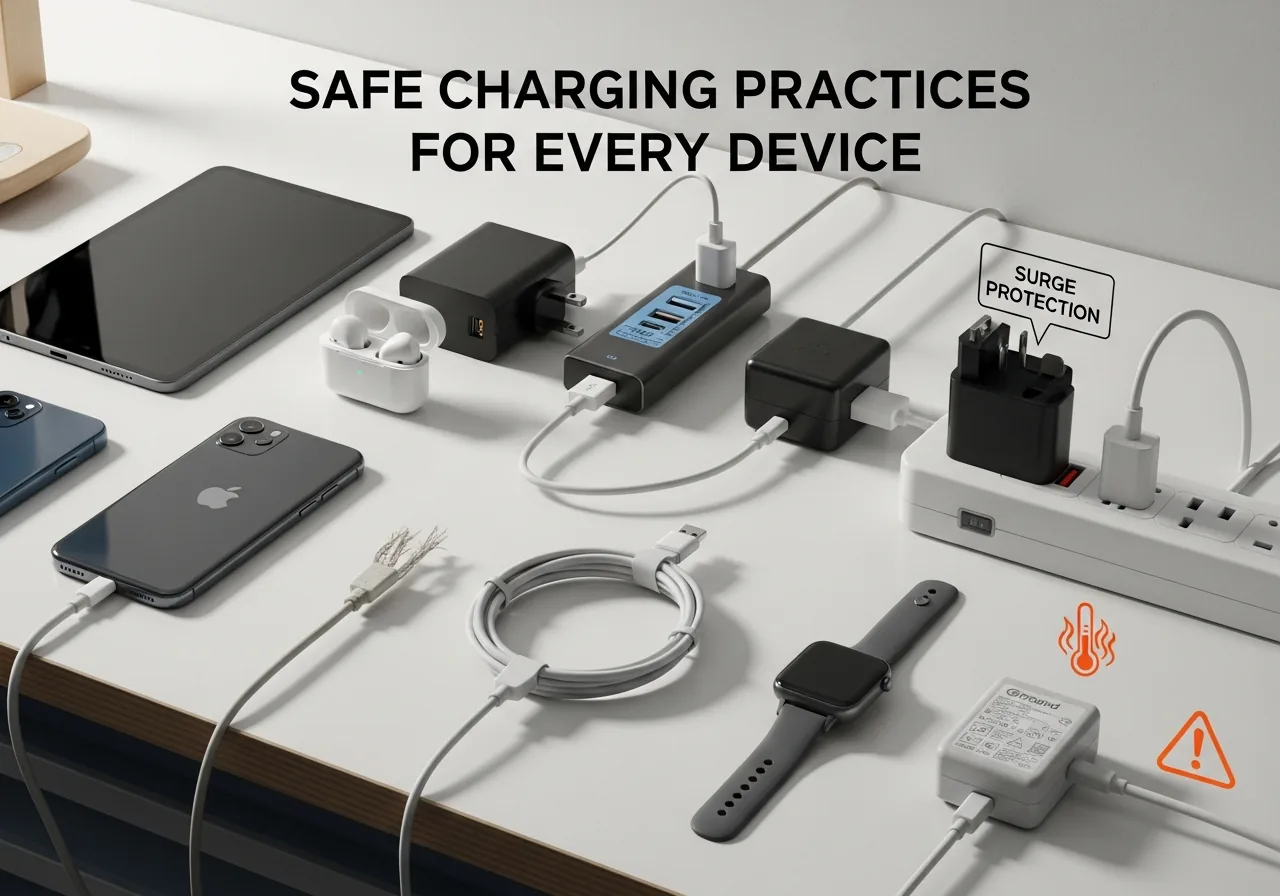
Safe Charging Practices for Every Device
Which chargers are safe to use, when to stop at 80%, and the habits that genuinely preserve battery health long-term. This guide explains the key concepts in plain language — no jargon, no marketing fluff, and no assumed prior knowledge. By the end you'll understand the underlying ideas well enough to make better decisions, troubleshoot common problems, and avoid the mistakes that cost most users time, money, or both. Everything below is written for everyday users who want to understand their devices a bit better, not for engineers or IT professionals.
Why This Topic Is Worth Understanding
Batteries power almost every device you carry, and how you treat them determines how long they last — both day to day and over their useful lifetime. Modern lithium-ion cells are remarkably reliable when used within their design parameters, but a few common habits can cut their lifespan in half. Understanding the chemistry at a basic level makes the right behaviour intuitive rather than something you have to remember.
How It Actually Works
A lithium-ion battery stores energy by moving lithium ions between two electrodes through a liquid electrolyte. Charging pushes the ions one way; using the battery lets them flow back, releasing energy to your device. Every full cycle of this movement causes microscopic chemical changes that gradually reduce the battery's capacity — this is what's meant by battery degradation. The rate of degradation depends heavily on three factors: how high you charge it (full to 100% is harder on the cell than stopping at 80%), how low you discharge it (running it to 0% repeatedly causes more damage than topping up at 30%), and how hot the battery gets during use and charging.
The Key Concepts You Need to Know
- Capacity (measured in mAh or Wh) determines runtime — but a higher number isn't always better if it makes the device heavier or slower to charge.
- Charge cycles are counted by the equivalent of full discharges; charging from 50% to 100% twice counts as one cycle, not two.
- Heat is the single biggest enemy of battery longevity. A battery kept above 35°C degrades several times faster than one kept at room temperature.
- Storing a battery at 100% (or 0%) for long periods accelerates capacity loss; the ideal long-term storage charge is around 50%.
- Fast charging produces more heat than slow charging, but on modern devices the impact on lifespan is small if cooling is adequate.
Common Mistakes People Make
Most battery damage is caused by heat, not by charging habits — yet people obsess about the latter and ignore the former. Leaving a phone or laptop charging on a bed, in a car on a hot day, or under direct sunlight will degrade the battery far faster than charging it to 100% ever could. The other widespread misconception is that you should fully discharge a battery before charging it, which made sense for nickel-cadmium batteries decades ago but actively damages modern lithium-ion cells. Topping up little and often is genuinely better for the battery than waiting for it to drain.

Practical Tips You Can Apply Today
- Avoid leaving your device charging in hot environments — direct sunlight, hot cars, under pillows, or on soft furnishings that block heat dissipation.
- For long-term storage, leave a battery at around 50% charge rather than fully charged or empty. Devices stored at extreme charge levels for months degrade noticeably faster.
- Use the manufacturer's charger or a reputable equivalent. Cheap third-party chargers often deliver inconsistent voltage that stresses the battery.
- Enable optimised charging (iOS) or battery health management (macOS, modern Android, modern Windows) — these features delay full charging until you actually need it, reducing time spent at 100%.
- For laptops you mostly use plugged in, set a charge limit (typically 80%) in your manufacturer's utility. This dramatically extends battery lifespan in this specific use case.
- Pay attention to background activity — apps with high battery drain are a sign something is keeping your CPU or radios busy when you don't need them to be.
Frequently Asked Questions
Should I let my battery drain to 0% before charging?
No. This was correct for nickel-cadmium batteries in the 1990s but actively damages modern lithium-ion cells. Top up the battery whenever convenient. Repeated full discharges age the battery faster than partial charges.
Is it bad to leave a laptop plugged in all the time?
On older laptops, yes — the battery would sit at 100% indefinitely, which accelerates degradation. Modern laptops typically have battery health management that stops charging at 80% when plugged in for extended periods. Check your manufacturer's utility for this setting.
Why does my battery die so much faster than when it was new?
Lithium-ion batteries lose capacity gradually with each charge cycle and additionally lose capacity when exposed to heat. After 2–3 years of regular use, most batteries retain 70–85% of their original capacity. Below about 80%, you'll start to notice the difference; below 60%, replacement is usually warranted.
Does fast charging damage my battery?
Modern fast charging is designed to be safe — devices throttle the charge speed as the battery fills and warms up to limit damage. The impact on long-term battery health is small if the device is allowed to cool properly during charging. The real damage from fast charging happens when combined with high ambient temperatures.
Related Articles & Categories
Apply this knowledge to your Smartphones and Wireless Charging Pads, or explore the related tutorials and guides below.